Understanding Your McLeod Cooperative Power Bill
Members can follow the numbers that are on the image of the sample bill that’s on the right-hand side of the page and the reference guide located to its left to understand your MCPA power bill.
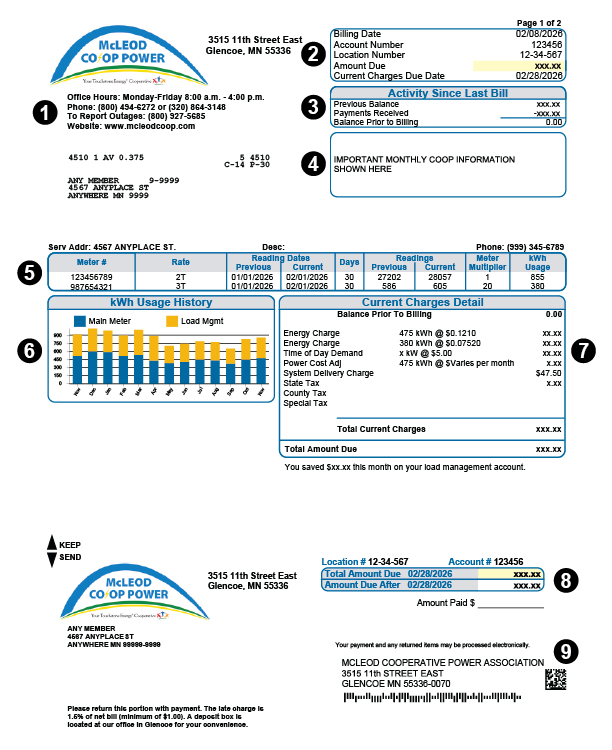
- General contact information, our phone numbers and office hours.
- The Billing Date, Account and Location Number, Amount Due and Due Date.
- Activity Since Last BIll contains the beginning balance, payments, adjustments and balance prior to the current billing.
- Message area to relay important information from McLeod Co-op Power Assn.
- The service address, phone number on file, meter information and reading dates print in this area.
- A monthly graph with 13 months of usage information.
- The Current Charges Detail is shown here, along with the total current charge amount. You can scroll down to the next section for more details on each billing item.
- The Total Amount Due and Due Date, along with member’s Account and Location number.
- Be sure to return the bottom portion of the bill with your payment. Please make sure the address is visible though the return envelope. We also accept payments in person at our office.
On the reverse side of the bill, find MCPA phone numbers along with terms and definitions.
Below are the three major components of your electric bill to ensure members have a good understanding of what makes up your bill.
1. SYSTEM DELIVERY CHARGE (SDC) – Keeping the Electricity Flowing
The System Delivery Charge (SDC) is a set (or fixed) amount that’s on your bill every month, regardless of the amount of electricity that you use. It covers some of the cost of materials like wires, poles, and equipment that bring power to your home, farm, or business. It also helps pay for customer service and things like restoring power during outages and trimming trees.
2. ENERGY CHARGE – Paying for How Much You Use
This is what you pay for the electricity you use each month. The amount of energy you use is multiplied by a rate called the per kilowatt-hour rate.
3. POWER COST ADJUSTMENT (PCA) – Changes in Electricity Prices
The PCA can either be a charge or credit on your bill. It’s based on how much the cooperative must pay for the variability of the costs to purchase electricity from our supplier, Great River Energy (GRE), as they purchase and sell power in the market from month to month.
4. DEMAND CHARGE – Paying for Your Highest Electricity Use
The Time of Day Demand (TODD) charge applies to Rates 2, 5, and 18. The charge is based on the highest level of electricity used (your demand) for the month, measured in kilowatts (kW), during On Peak Hours of 5 PM to 9 PM, Monday through Friday (excluding holidays). The Time of Day Demand (TODD) charge is based on the highest level of electricity used (your demand), measured in kilowatts (kW), during On Peak Hours of 5 PM to 9 PM, Monday through Friday. That one peak in the month — the highest of all days — is used to calculate the account’s monthly TODD charge.
Excluded Holidays: New Year’s Day, Memorial Day, Independence Day, Labor Day, Thanksgiving Day, and Christmas Day.
Demand (kW) is the amount of power needed to supply everything running off of electricity in your home at a specific point in time. That means all the appliances and equipment that are running simultaneously at any time. Your peak demand is the highest level of electricity used, measured in kilowatts (kW), during the month.
Are you looking to save $ on your monthly bill?
Download our guide for saving energy (PDF). It features over 20 tips on how to save money on your monthly bill.
Have additional questions?
If you have additional questions on understanding your bill, please give us a call!