Starting in January (2026), your bill will display your monthly peak demand charge during the On Peak timeframe (weekdays from 5-9 PM). The Time of Day Demand charge for Rates 2, 5, and 18 helps MCPA recover a portion of the demand charges we pay monthly on our wholesale power bill.
With this change, all rate classes now include a demand charge in their monthly billing. Again, this is effective on January 1st, 2026.
With the new TODD charge, the 2026 kWh energy rates for Rates 2, 5, & 18 have decreased, making the kWh rates cheaper in 2026 than the 2025 rates.
UNDERSTANDING DEMAND
Demand varies from hour to hour, day to day, and season to season. You could use the same amount of electricity as your neighbor on any given day, but if you are using most of that electricity during one hour after work, your demand is higher than your neighbor’s.
Demand (kW) is the amount of power needed to supply everything running off of electricity in your home at a specific point in time. That means all the appliances and equipment that are running simultaneously at any time. Your peak demand is the highest level of electricity used, measured in kilowatts (kW), during the month.
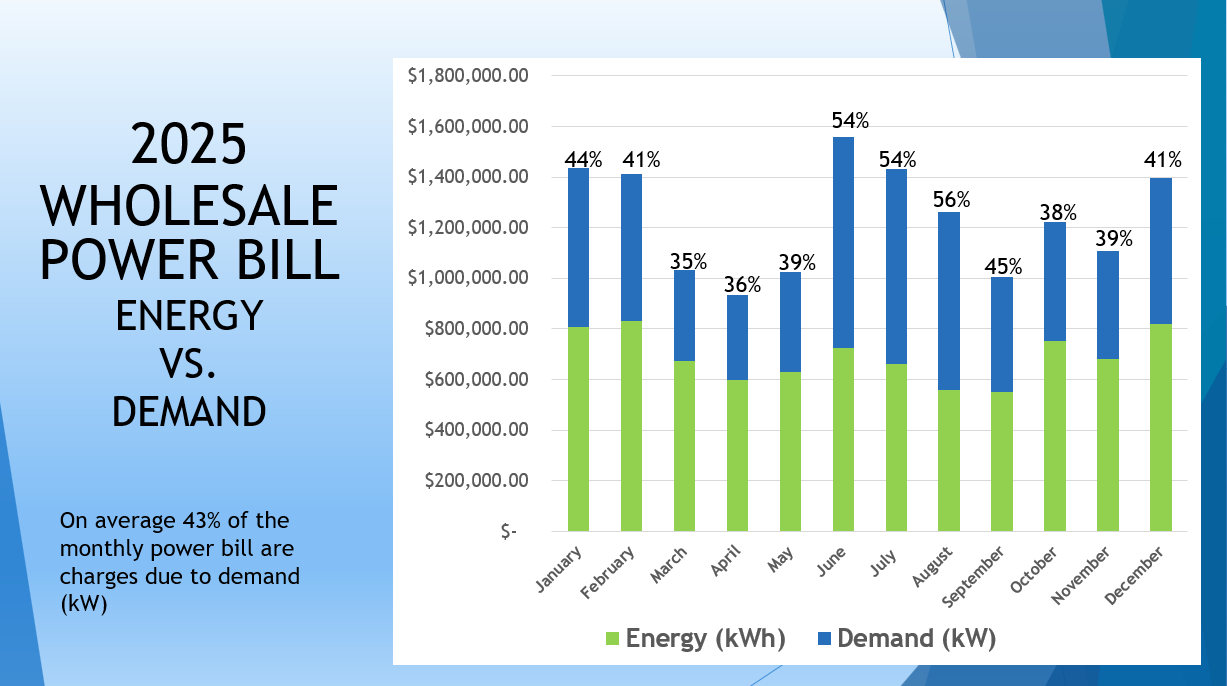
Demand charges account for roughly 25–30% of MCPA’s monthly wholesale power bill from Great River Energy. Here’s another way to look at it:
out of every dollar you pay McLeod Cooperative Power, about 61 cents goes directly to paying Great River Energy.
We are designing rates to reflect the true costs of supplying power, and demand costs are a significant consideration as members are being asked to pay for the demand costs that they generate.
Learn about the new Time of Day Demand Charge:
Proposed 2026 Time of Day Demand Rate (TODD)
When You Use Power Matters
The Time of Day Demand (TODD) charge applies to Rates 2, 5, and 18. The charge is based on the highest level of electricity used (your demand) for the month, measured in kilowatts (kW), during On Peak Hours of 5 PM to 9 PM, Monday through Friday (excluding holidays). The Time of Day Demand (TODD) charge is based on the highest level of electricity used (your demand), measured in kilowatts (kW), during On Peak Hours of 5 PM to 9 PM, Monday through Friday. That one peak in the month — the highest of all days — is used to calculate the account’s monthly TODD charge.
Excluded Holidays: New Year’s Day, Memorial Day, Independence Day, Labor Day, Thanksgiving Day, and Christmas Day.
Members can lower their demand by shifting energy use away from the on-peak period. Small changes like doing your laundry on the weekends or running your dishwasher after 9 PM will lower your On Peak demand.
WITH THE NEW TIME OF DAY DEMAND (TODD) CHARGE, THE ENERGY RATE FOR RATES 2, 5, & 18 HAS DECREASED FOR 2026.


Learn More about Lowering Your Demand:
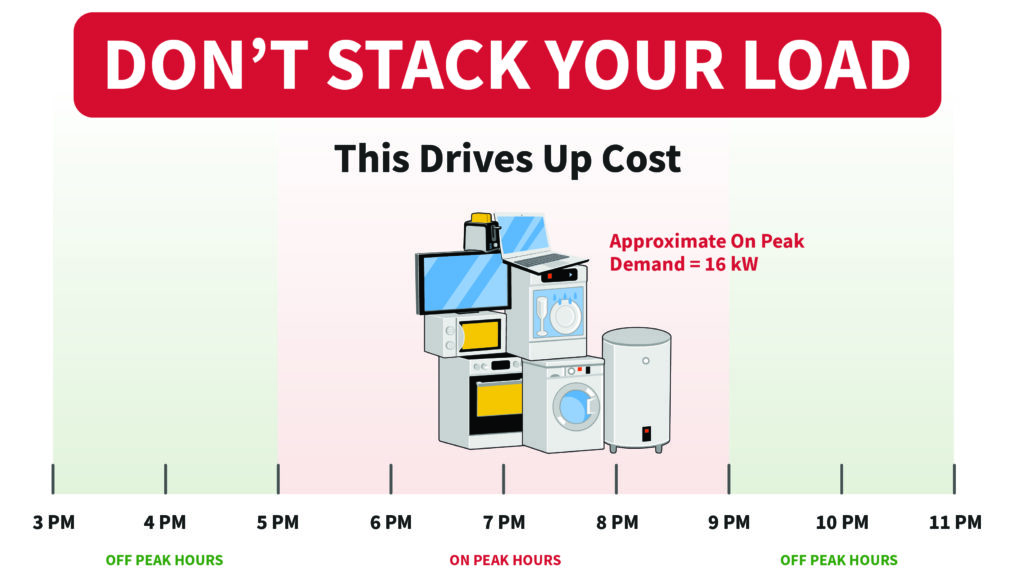
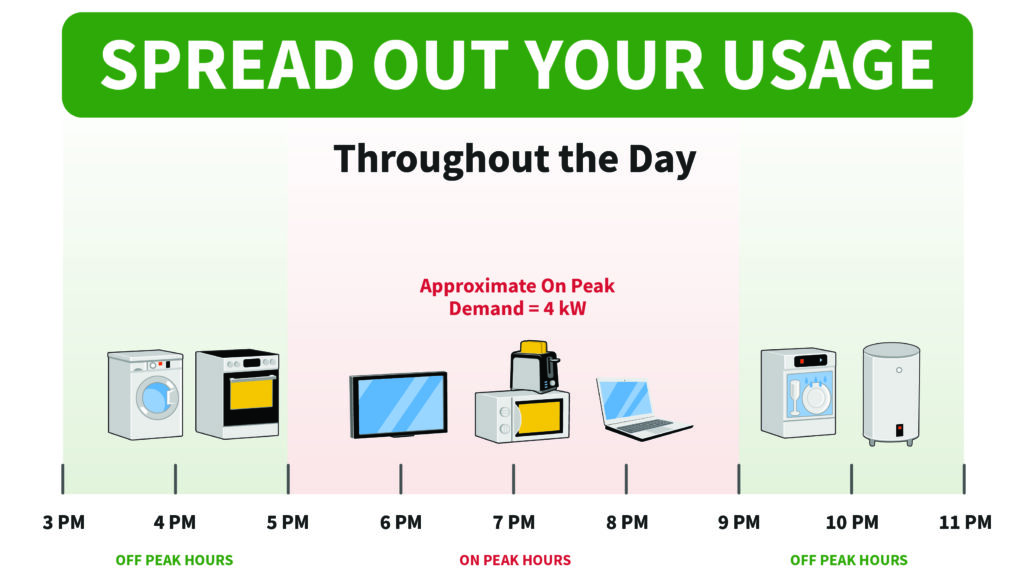
Here are a few easy strategies to reduce your demand and save money:
1. SHIFT HIGH-USE ACTIVITIES Many household appliances, such as dryers, ovens, and dishwashers, use significant electricity when running. Using them all at once, especially between 5 p.m. and 9 p.m., can quickly raise your peak demand. Try doing laundry earlier in the day or setting the dishwasher to run after 9 p.m. If possible, wait until the weekend for high-use tasks, since weekends are considered off-peak hours. Spreading out your appliance use helps flatten your peak and balances demand across the system. Members with EVs can also lower their TODD charge by charging their vehicles during off-peak times.
2. ENROLL IN LOAD MANAGEMENT PROGRAMS Our Energy Management programs automatically shift certain appliances to run during off-peak times. Options like Off-Peak Water Heating, Dual Fuel Heating, Off-Peak EV charging, and Storage Heating not only reduce demand but can also qualify you for lower electric rates and generous rebates. These programs are a win-win; they help members save while keeping costs stable across the cooperative. Click here to learn more about these programs.
3. USE SMART CONTROLS AND TIMERS Smart thermostats, outlet timers, and appliance delay features can make shifting usage effortless. Program your thermostat to pre-heat or pre-cool your home before peak hours. Use timers to run water heaters or EV chargers overnight. These small, automated changes can reduce on-peak demand without disrupting your daily routine. By learning how your energy use behaves now, you’ll be ready to take advantage of future savings opportunities.
These are just a few simple strategies to shift power away from the On Peak hours and save on your power bill. We’re here to help you find the solutions that work best for your needs and budget.
If you have questions, give us a call at 320-864-3148.